Vandit Kalia, 19 January, 2025
Congrats – you are the proud owner of a shiny new Open Water card. That card is a key that opens the gate to a whole new world – but now you actually need to go through.
But surprisingly, an overwhelmingly large number of people never dive again after certification. And even among those that do, the first few dive trips can be quite stressful.
In this article, we help you, the newly certified diver, start off on the right foot in terms of starting your scuba journey.
BARRIERS TO DIVING
There are, in general, a few reasons why newly certified divers are hesitant to go diving afterwards. Some of these are as follows:
- Poor experience in the training course – something in the training program has led to a negative association with the sport. Typically, difficult conditions, difficulty with a particular skill or a bad experience during the dive itself
- Lack of confidence – many divers, despite getting a certification card, lack confidence in their abilities, and so are hesitant to go diving without an instructor to assist them
- Lack of a peer group – typically, diving involves traveling to different countries, and lack of diving friends can be a deterrent for many people
- Time / costs – well, there is no denying that time and/or money can both be a deterrent to diving
FREE YOUR MIND
You’ll notice – most of these issues actually are mental. And the solution comes from having a better understanding of the sport and how you fit in it.
To start with, don’t let a bad experience put you off the sport. The risk of bad experiences is present everywhere in life – pineapples on pizza, annoying co-workers/neighbors, a visit to VFS for visa applications, etc. But we don’t let those bad experiences put us off good pizza, friends or travel, do we?
The same holds for diving. A bad experience is simply a lesson on how to do things better next time – in most cases, there is a solution to achieve this goal, and so it should not be reason to quit the sport.
Secondly, many people feel overwhelmed by the idea of diving without an instructor to watch over them. Others feel nervous at the idea of being newbies on a dive boat, and are afraid of messing things up. And yet others feel that they really are lacking critical skills.
Now, if you genuinely feel that you are lacking the skills needed to dive as a certified diver, that simply means you should sign up for some remedial training. There is no such thing as someone who doesnt know how to dive – there are people who know how to dive, and there are people who are still learning how to dive. The fact that you haven’t mastered some skills yet simply means you may need another session or two… progress is a given, as long as you work at it.
As for ability to manage a dive underwater, look at it this way: at any point, if you are having an issue, all you need to do is slowly ascend to the surface. It is a minute or two away (less in an emergency) at Open Water depths. So what are you worried about? Navigation can be challenging, but hey, that’s why most tropical dives have a divemaster leading the dive.
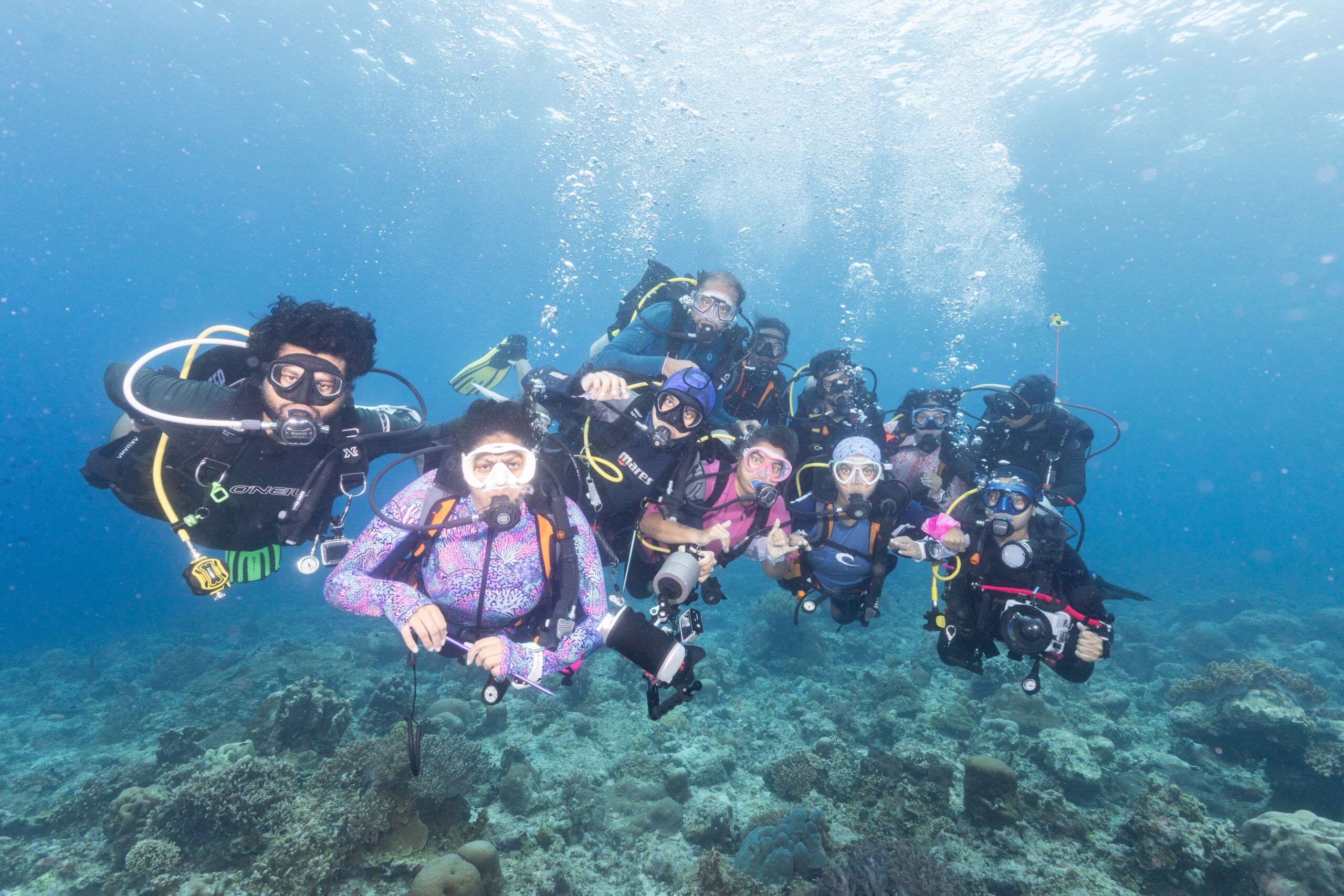
Lastly, the diving community is, for the most part, very supportive (atleast in the real world – scuba forums are a different beast altogether). Everyone has been a beginner once, and as long as you are diving conservatively and trying your best, you will get nothing but support from others on the boat. And in any case, it’s not your job to worry about other peoples’ dive experience – let the dive pros on the boat figure that out. You have paid for your diving, focus on enjoying yourself!
Diving is also a surprisingly social sport – on virtually every boat, you will see solo divers coming on the trip. And by the end of the day, the whole boat is laughing and sharing photos/videos/Instagram handles, and making plans to go have pizza (without pineapple) afterwards.
So don’t let the lack of a diving friend put you off – you are as likely to make new diving friends when you go on a dive trip (and because they are divers, they are going to be cooler than your non-diving friends :)).
THE REST THAT FOLLOWS
Ok, now that we are done with the mind/spirit stuff, let’s get into some tangible specifics. Here are a few things I recommend you do:
- Sign up for a dive trip – this sounds like a cheesy PADI video, but the longer you wait to use your card, the harder it will be for you to overcome your inertia. There are plenty of studies on habit formation that talk about this, and as Confucious said, man who go to sleep with itchy… no, not that one… a journey of a thousand miles starts with one step (and a packed pizza without pineapples). This doesnt have to be a big, expensive dive holiday – just go for a weekend trip to Goa, Netrani, Pondicherry or wherever, if need be.
- Sign up with a dive club/group – there are several dive clubs and/or Whatsapp groups bringing together divers into a community. Eg, we at India Scuba Network have a Telegram community for divers across the country, Bangalore Scuba has an active Whatsapp group, etc. This is a great way to meet other divers, plan dive trips together and stay connected as a part of the diving community. Even if you don’t have one specific to your city, join a different one. Many of the dive trips and events that are planned are open to all.
- Do a buoyancy/finishing class ASAP – after certification, one session with an instructor to polish your skills, fix any issues that came up during the class and build upon your buoyancy is a great way to level up your diving skills. Failing that, doing an Advanced class or even a handful of dives with an experienced dive pro who can give you feedback can also yield significant improvements.
- Use the safety stop wisely – the safety stop is a great way to work on any dive skills that you think need polishing: be it mask cleaning, air sharing, deploying an SMB or just working on your breathing and buoyancy control. Use those 3 minutes well.
- Take advice from reliable sources – to the surprise of no one, the Internet is full of bad advice especially online forums where virtue signalling is used as a way of competing with other divers. And then you have divers with intermediate experience who extrapolate their preferences and experiences into objective realities. Diving is not complicated. It is meant to be fun. Keep it that way and don’t overthink things.
Welcome to the sport and safe diving!